Fact
Controlled
MATH
for
Special Learners
Busman's Holiday
OmniPage, Fred, and...
by Steve Wood
August 23, 1999
Fact
Controlled |
Busman's Holiday |
mathdittos2.com
|
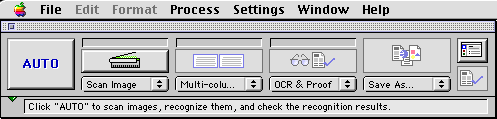
A column about a product over 18 months old isn't exactly earth shattering news. Of course, if you haven't used the product, it seems new to you. That's the position I find myself in with Caere's OmniPage Pro 8. I still remember how thrilled I was when I finally got the OCR function of my Global Village fax/modem software to work occasionally. It was my first taste of the capabilities of optical character recognition (OCR) software. Although it crashed my Performa 575 as often as not, it was a marvelous tool when it worked. But it really was just a novelty for me. Since that time, I've switched modem brands more than once and really haven't had much need for an OCR program. That changed when someone at school thought the PTO really should get me a scanner for classroom use. I certainly didn't argue, even though there are probably 50 other things we need with a higher priority. The few times I really needed a scanner I was able to use one in a friend's office. It was one of those "a scanner or nothing" deals. With the arrival of a UMAX 1200S (yes, we recycle the included SCSI cards back to the high school's Windows brethren), the need for something more than the bundled limited edition OCR became apparent. I wanted editable text so that I could scan the kids' stories from their readers into the Mac, change them to text, and let "Fred" read to them. While Fred isn't really a captivating speaker, he does a pretty good job of pronouncing words and his memory requirement doesn't seem too bad. For those of you who are now wondering if I've lost my marbles...hmm...maybe. Fred is just one of the voices available in the Speech control panel installed by Apple's current Text-to-Speech. While I've tried some of the high quality voices such as Bruce and Victoria, Fred still serves our needs best. Text-to-Speech installs by default with OS 8.5 and later. It is an option that must be manually selected with earlier system software. Fortunately, I'd read a column on OCR somewhere (Why don't I take better notes?) that compared OCR programs available for Macintosh which narrowly gave Caere's OmniPage Pro the nod over Xerox's TextBridge as the best available. Fortunately again, I'd also seen a Deal-Mac posting about an obscure Caere link that offered the full version of OmniPage Pro 8 for just $69 (still available on Amazon I use the VistaScan 3.5.1 drivers for the UMAX 1200S, even though they're not listed as compatible for my scanner. They work much better than the software that came with it. There's an update (226K) on Caere's site that adds support for many more scanners to OmniPage Pro 8. Also, there's an OmniPage 8.0.1 update (2.7 MB) available. Scanning text into OmniPage is a snap. Clicking "Auto" will scan and start the OCR and proofing process. You may also manually scan and then select the "OCR & Proof" command after possibly cleaning up the scanned image a bit.
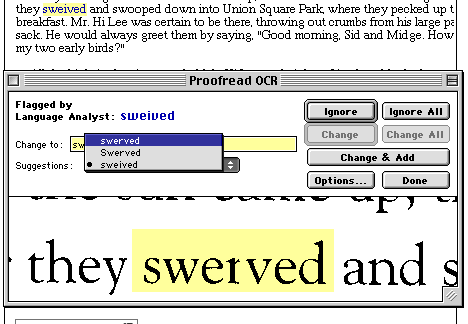
Once you select the "OCR & Proof" command, OmniPage leads you through a proofing process much like a spell checker. The original text in question is also presented in magnified form which is a great help in deciding whether something is correct or not.
While not even close to perfect, OmniPage does seem to approach the manufacturers claims of 99% accuracy scanning from clear text without any adornments on the page. Scanning pages with color and/or picture backgrounds can make the proofing process much more involved, but still clearly doable. The focus of my OCR efforts as mentioned above was to get editable text copies of stories from the many different readers we use in my special education classroom. While still early in the school year, the results from having kids use Text-to-Speech to read the stories to them seems to be helpful. I've already noticed several kids highlighting just one word for pronunciation by the software. That's a good sign that they are focusing on the words they don't know. Curry Software's The Reading Machine could also be used with scanned text files for paced left to right reading practice. It also uses the Macintosh speech capability in its "Book" mode, but doesn't highlight the word being read. OmniPage, AppleWorks, and Fred won't replace good old oral reading practice, but they appear to be one more tool that can be added to a teacher's bag of tricks to help troubled readers.
Send your feedback to |
|
©1999 Steven L. Wood
 ). The link was to Digital River for an online purchase, but I chose their option to have the full version with a real-for-true paper manual mailed to my home. OmniPage Pro 8 requires a Power Macintosh running system 7.5 or later, 10MB RAM, at least 25MB of available hard disk space, and a compatible scanner.